Why Crypto Casinos Face Growing Compliance Demands
Crypto casinos face tighter AML, KYC and payment rules. We take a closer look at the regulatory tools behind the shift and what operators need to know.
 Alissa Bergman

For most of their history, crypto casinos operated in a gray zone. An operator could hold an offshore licence and freely accept deposits in stablecoins or any crypto. Today, the model is under pressure from several directions at once.
This pressure is coming not only from gambling authorities, but also from anti-money laundering organizations, banks, payment networks, and advertising platforms. It is a worldwide trend, but it is especially apparent in Europe, where new measures are increasing oversight and coordination.
FATF: The Risk Is Now Documented
The Financial Action Task Force published its Risks of Gaming and Gambling report on 9 September 2026; it is the first detailed FATF global assessment of risks specifically associated with online and illegal gambling, with contributions from over 80 jurisdictions.
The group said cash, e-wallets, mobile money and virtual assets were payment channels particularly vulnerable to abuse, especially when transactions were split into small deposits to avoid reporting.
FATF considers land-based and online casinos and sports betting the most exposed areas. It treats virtual assets as part of a broader picture that also includes e-wallets and the services around gambling platforms.
Therefore, the claim that crypto casinos face the strongest pressure is an inference, not a FATF finding. However, it is a reasonable assumption. Crypto combines the vulnerabilities identified by the FATF, such as offshore structures, anonymity and cross-border activity. The FATF has also noted that the illegal market in some jurisdictions can be larger than the regulated one.
The broader crypto agenda is narrowing too. Stablecoins, peer-to-peer transfers using unhosted wallets, offshore virtual asset service providers (VASPs), cross-chain activity and decentralized finance (DeFi) are the key pressure points identified in its July update.
At its October plenary, the FATF agreed to review jurisdictions with significant virtual asset sectors, with results expected in June and October 2027.
The Push for KYC
Europe is converting these principles into binding law. From 10 July 2027, the EU’s Anti-Money Laundering Regulation (AMLR) applies directly across member states. It keeps gambling providers among obliged entities and requires customer due diligence at €2,000 when a stake is wagered, or winnings are collected.
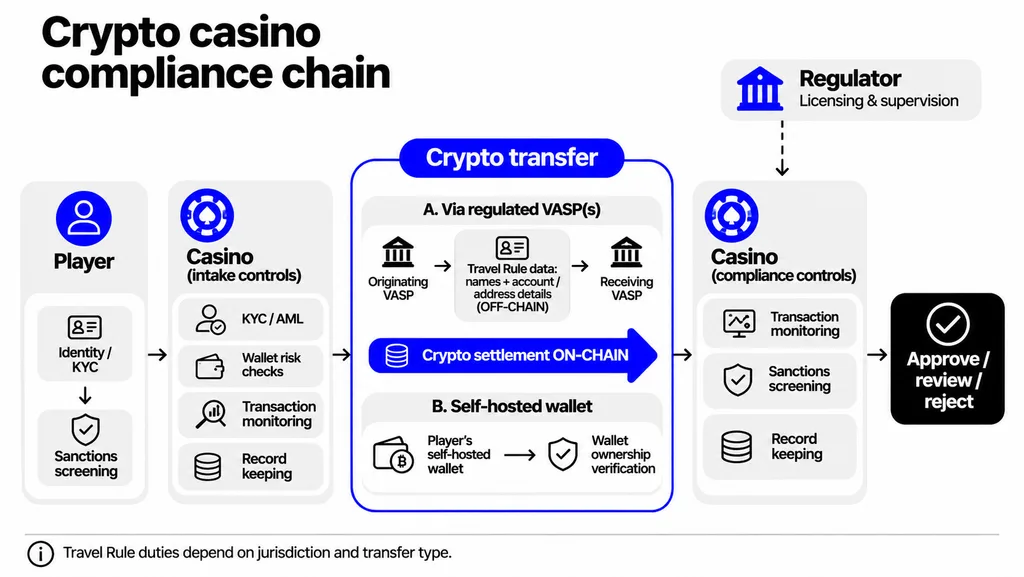
The crypto-specific provision in Article 79 prohibits credit institutions, financial institutions and crypto-asset service providers (CASPs) from keeping anonymous accounts, including accounts that enable anonymization through anonymity-enhancing coins.
The ban applies to exchanges and custodians, not casinos directly. The regulation does not prohibit holding such coins in a personal wallet. Privacy coins will be affected indirectly, as the exchanges and banks that serve casinos will stop handling them.
The Travel Rule works the same way. The EU’s Transfer of Funds Regulation has been fully applicable since 30 December 2024. For transfers above €1,000 involving a self-hosted wallet, the CASP must verify that its customer actually controls that wallet. While casinos are not directly bound by the regulation, their players’ exchanges are. Players withdrawing from a regulated exchange to a casino deposit address may experience delays, questions and blocked transfers. Data transparency is also growing: the OECD’s CARF framework took effect on 1 January 2026, with international exchange of the collected data beginning in 2027.
The EU’s Markets in Crypto-Assets Regulation (MiCA) adds another layer of regulatory scrutiny to the casino crypto infrastructure. Its transitional period expired across the EU on 1 July 2026. Now, crypto-asset service providers must hold the required MiCA authorization to continue serving EU clients.
Legal commentary stresses that a casino accepting crypto does not automatically become a CASP, but embedded swaps or custody features may bring an operator into CASP scope. Therefore, the safer approach for operators is to ensure that their crypto partners hold valid authorisations.
Curaçao: Crypto Stays, With Conditions
Curaçao issues licenses to many crypto casinos, so its rules carry extra weight. In June 2026, the Curaçao Gaming Authority (CGA) issued a crypto guideline for its B2C licensees. Operators may only accept crypto as payment for gambling, without conversion, swapping or holding for players outside of gambling transactions. Assets associated with sanctioned wallets, mixers, or tumblers are forbidden.
The rollout is phased. Licensees were required to upload a crypto policy to the CGA portal by September 2026. By December, they must complete risk assessments, due diligence on third-party VASPs, wallet ownership controls, and staff training. Privacy coins are not banned outright. One legal summary says they require assessment or outright exclusion. The licence remains available, but the substantive bar is rising.
The Real Enforcement Tool: Payments
Authorities increasingly target the infrastructure behind unlicensed sites rather than the sites themselves.
In Britain, the Illegal Gambling Taskforce launched in January with participants including Google, Mastercard, TikTok and Visa. One of its three objectives is to prevent or reduce payments to illegal operators. Industry estimates put stakes with unlicensed operators in 2025 at £16.6 billion.
In the United States, pressure comes from the states. Florida’s attorney general warned Visa, Mastercard and American Express that serving offshore operators may breach the state’s RICO Act. Michigan’s regulator sent cease-and-desist letters to 33 offshore operators in October, after 45 earlier in the year.
One caution applies here. There is no centralized registry of unlicensed operators managed by card networks. Reportedly, Visa and Mastercard maintain internal registries of merchants, but these are not accessible to the public. Enforcement is carried out using a variety of tools, including regulatory blacklists, cease-and-desist notices and ISP blocklists.
A Tougher Game for Offshore Casinos
Offshore crypto operators will not disappear, but they are losing their ability to manoeuvre. Stake, one of the largest platforms, blocked access to users in Ireland after talks with the Irish regulator, following the loss of its UK licence in 2025.
Banking relationships, advertising access and the quality of available suppliers are the pressure points. Curaçao’s supplier-licensing deadline of 24 December 2026 could be a watershed moment for game libraries in particular: B2C companies must make sure that their content providers comply with the new requirements; otherwise, they may have to remove games from providers that don’t the necessary approval.
A Counter-Trend: Regulated Crypto
Regulation is not only tightening. In February 2026, the UK Gambling Commission asked its Industry Forum to explore a “sensible” approach to allowing licensed operators to accept cryptocurrency payments. The regulator reasons that cryptocurrency is one of the most common search terms that lead consumers to illegal sites. However, any such pathway will depend on the Financial Conduct Authority (FCA) regime, which is expected on 25 October 2027. The direction lies in traceable cryptocurrency transactions, verified participants, and regulated service providers.
Triggers to Watch:
- 24 December 2026: CGA supplier deadline and six-month crypto milestone.
- 22–26 February 2027: next FATF plenary.
- June 2027: CGA blockchain-analytics deadline and first FATF virtual-asset review results.
- 10 July 2027: AMLR applies, with €2,000 CDD for gambling and anonymous-account bans for CASPs.
- 25 October 2027: FCA crypto regime, the precondition for any UK pathway.
- Ongoing: payment-network actions, state cease-and-desist waves and advertising certification changes.
Wrapping Up
The trend is consistent across jurisdictions: crypto stays, whereas anonymity disappears. High-tier licenses will soon be incompatible with online casinos that don’t have robust KYC, while offshore operators will face more expensive and restrictive banking, advertising, and supplier access. Some jurisdictions access and control casinos through exchanges, banks, and payment providers rather than directly, so the practical test for an operator will be whether its entire payment chain can withstand scrutiny.