The Growth Trap: Why Bigger iGaming Operators Are Not Always More Profitable
Why doesn't scale always translate into profit in iGaming? Explore the hidden costs of expansion, the limits of operational efficiency and strategies for sustainable, profitable growth.
 Irina Polovinkina

In iGaming, bigger is not necessarily better. As operators expand into new markets and attract more players, rising acquisition costs, increased regulatory demands and greater operational complexity can reduce profit margins. The key challenge lies in turning growth into sustainable profitability.
When Growth Stops Creating Value
In the iGaming industry, growth is often seen as a sign of success. Rising revenue, an expanding player base, and entry into new markets all suggest that a business is moving in the right direction. As operators grow, the costs associated with acquisitions, licences, technology, payment processing and compliance can increase faster than revenue, putting pressure on margins.
This makes it essential to look beyond headline revenue and assess the profitability of individual markets, acquisition channels and products, as well as the capital required to sustain them.
Growth can, paradoxically, become a glass-ceiling effect for the operator. The challenge is less that the brand has no room left to grow than that sustaining its reputation and its current player and user base demands greater investment, for instance, hosting affiliate events, private dinners, or CEO meetings.
Flutter Entertainment’s 2025 results highlight the distinction between revenue growth and bottom-line performance. Revenue increased by 17% to $16.38 billion, while adjusted EBITDA rose by 21% to $2.85 billion.
However, it is important to bear in mind that adjusted EBITDA does not account for a whole range of expenses. This single metric does not provide a complete picture of the true standing of a major player, all the more so given that, in parallel, Flutter is reporting losses. The company also reported a net loss of $407 million, largely reflecting a non-cash impairment associated with regulatory changes in India.
Put simply, despite the operator’s size in the iGaming industry, it is still losing money due to circumstances beyond its control partially. While a smaller company might, for instance, adapt to new rules easier by moving to an online-only model or opening an office in another country, large companies find themselves trapped. Closing or replacing an office means losing market presence, making sweeping layoffs, and often facing litigation, tax claims and additional costs.
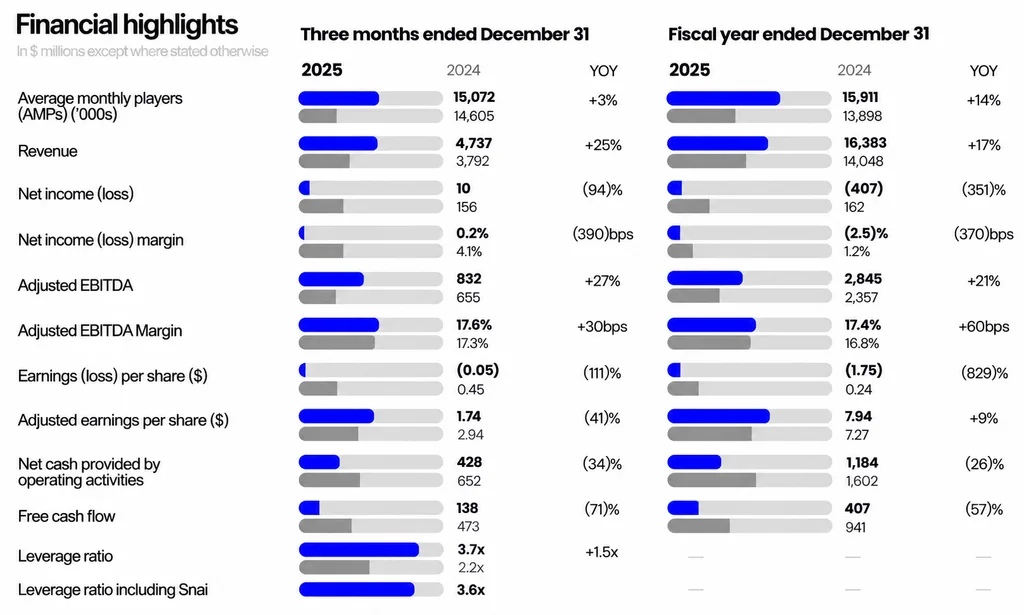
Key financial highlights. Source: Flutter Entertainment’s Report
The Hidden Costs of Scaling
Expansion brings more than new revenue streams. Importantly, operating costs do not always rise in proportion to revenue.
Each new jurisdiction introduces its own legal requirements, tax structure and operational demands, while a larger customer base requires more sophisticated infrastructure, fraud prevention and customer support.
Entain’s 2025 annual report illustrates the scale of these costs: betting and gaming taxes rose from £1.19 billion in 2024 to £1.31 billion in 2025, while salaries and related expenses increased from £843.1 million to £883.1 million.
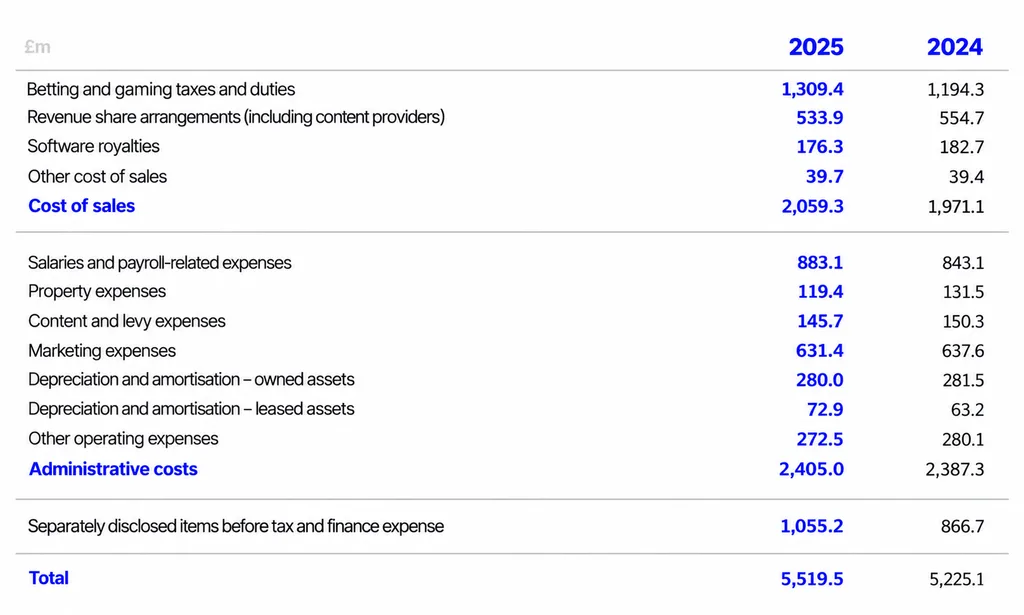
Entain’s operating costs. Source: Entain’s Report
We observe moderate cost growth. In this case, Entain’s strength lies in its ability to manage administrative expenses and absorb inflation, as evidenced by the payroll and payments line.
On the other hand, separately disclosed items rose by 21.8%, exceeding £1 billion (rising from £866.7 million to £1,055.2 million).
This is an enormous sum, nearly 20% of total costs. This category typically includes goodwill impairment write-offs, legal costs, regulatory fines, and restructuring or M&A expenses.. This situation will have a significant impact on statutory profit, even if the operating business is performing steadily.
The larger the company, the larger the figures it commands. Smaller companies and businesses in the iGaming space find it easier to manage such expenses, notwithstanding their lower profits.
More Players, More Markets, More Complexity
Expanding into new markets and GEOs and attracting more players unlock significant growth opportunities for iGaming operators. Each new market requires investment in customer acquisition, localised products, payment infrastructure, and regulatory compliance. At the same time, established markets may demand increasingly sophisticated retention strategies to remain competitive.
Customer Acquisition Costs are particularly important. If operators rely on expensive campaigns, aggressive promotions or affiliate partnerships to sustain growth, the cost of attracting new players can erode the revenue generated. Retention determines whether those acquisition investments deliver lasting value. A growing player base means little if users quickly disengage or require continuous incentives to remain active.
Beyond acquisition and retention, operators must also balance local market needs with the efficiencies of a centralised business model. Entain’s 2025 results illustrate how scale can support profitability when combined with disciplined execution: underlying EBITDA increased by 8% at constant currency, while its online underlying EBITDA margin rose to 25.7%.
Therefore, the objective for iGaming leaders is not simply to acquire more players or enter more markets, but to build a portfolio in which each GEO, acquisition channel and customer segment contributes sustainably to the bottom line.
Economies of Scale vs Diseconomies of Scale
For iGaming operators, achieving scale can be a competitive advantage, but only if growth improves efficiency rather than increasing costs more quickly than revenue. Larger businesses can spread fixed costs across more players and markets, making investments in technology, cybersecurity, analytics, and platform development more cost-effective per user. Centralised functions, shared infrastructure and consolidated purchasing can further reduce duplication and support stronger margins.
Technology plays a decisive role here. Scalable platforms and automation enable operators to handle increased transaction volumes and user numbers without proportionally raising headcount or infrastructure costs. However, higher volumes can also lead to increased spending on payment processing, fraud prevention, customer support and system reliability.
Management structure is equally important. While centralisation can streamline decision-making and eliminate duplicated functions, excessive control can impede local teams’ ability to respond to market-specific conditions. Successful operators strike a balance between group-wide efficiency and the flexibility required in individual jurisdictions.
Ultimately, scale creates value when revenue and productivity grow faster than the costs of running the business. Monitoring operating expenses, market-level margins, and customer acquisition efficiency helps executives identify when expansion is generating sustainable growth.
How to Scale Without Sacrificing Profitability
Sustainable growth requires iGaming operators to evaluate expansion opportunities by their long-term contribution to profit, rather than revenue potential alone. Before entering a new market, executives should assess licensing and tax costs, competitive intensity, CAC, payment fees and the time required to reach break-even. Setting clear profitability targets for each jurisdiction helps prevent expansion from becoming a drain on the wider business.
DraftKings’ 2025 annual report highlights a central challenge of market expansion: entering a new jurisdiction requires investment in customer acquisition and retention before the business reaches a critical mass of engaged users. This creates a gap between the initial cost of entry and the point at which a market can deliver sustainable returns. Scalable technology may limit incremental launch costs, but it cannot eliminate spending on marketing, customer support and regulatory compliance. The commercial test is therefore not simply whether a new market attracts players, but whether its unit economics can support profitable growth as the business matures.
Aggressive bonuses and paid campaigns can accelerate registrations, but their value depends on whether acquired players remain active and generate sustainable returns. Operators should track LTV against CAC, alongside retention, payback periods and net revenue after bonuses.
This does not necessarily mean that a loss-making GEO should be shut down immediately. In practice, such GEOs are often funded with an eye to the future, for example, when a new vertical is still being built up, or when it has long been part of the core GEO mix. Tier-1 GEOs, such as USA or Western Europe, are a case in point: they may already have a large high-intent audience, yet competition remains fierce and periodic downturns are inevitable.
And although this weighs on margins and can at times bring substantial losses to the product, it helps uphold the reputation and stability of the business as a whole.
Comparing contribution margins across markets, brands and acquisition channels helps identify where additional investment is justified and where costs need to be reduced. Shared technology and centralised functions can improve efficiency, while local teams should retain enough flexibility to respond to regulatory and consumer differences.
Wrapping Up
Operators that monitor unit economics, balance acquisition with retention and invest in scalable technology can strengthen margins as they grow. Ultimately, the winners will not necessarily be the biggest businesses, but those that turn scale into efficiency, complexity into control and new opportunities into lasting profitability.