Meet our first guest: Alexandra Voronetskaya!
We are delighted to present the first guest in our new interview series: Alexandra Voronetskaya, CCO at The Playa.
Interview with Alexandra Voronetskaya, CCO at The Playa
 Marie F
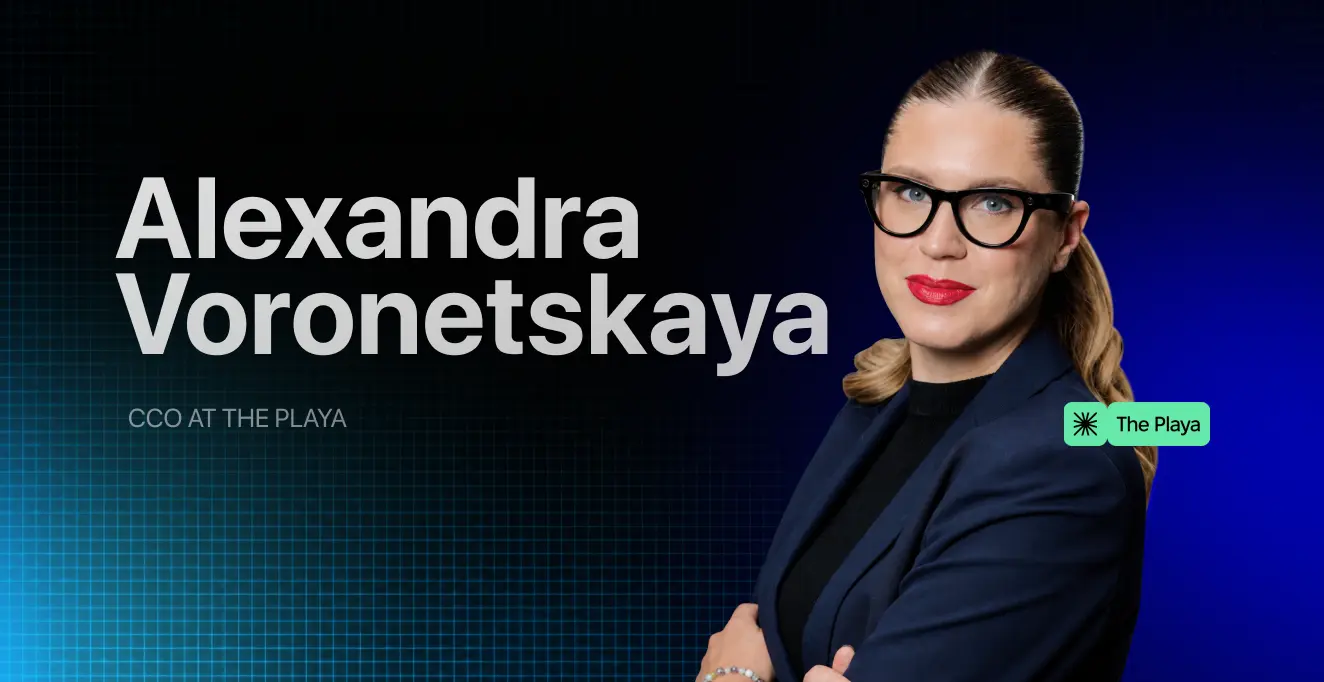
We are delighted to present the first guest in our new interview series: Alexandra Voronetskaya, CCO at The Playa. She will guide us through the world of iGaming, where we will discuss how to create a unique and valuable gaming experience.
Alexandra will share her insights on personalisation, player behaviour, trust, artificial intelligence and the role of data in the gaming process. She explains how traditional metrics are changing, and what really matters to players at any given moment.
Can we improve the gaming experience by offering more, or by making it more relevant? You’ll find the answers to these questions in our interview.
What Makes a Better Player Experience?
Clast: Player experience is increasingly discussed as a business metric rather than simply a product priority. What does a strong player experience actually mean from a commercial perspective?
Alexandra: For me, the two key words are healthy and sustainable.
A strong player experience should not be measured by how much activity you can generate from a player today. Commercially, the much more important question is whether you are creating an experience that gives that player a reason to come back tomorrow, next week and next month.
That changes the way we think about metrics. It is not simply GGR or session length. It is relevance, repeat activity, retention, LTV, trust and ultimately the quality of the relationship between the player and the operator.
And I think this is where responsible gaming and commercial performance are much closer than people sometimes assume. A sustainable player is more valuable than a player you exhaust through irrelevant bonuses, aggressive communication or content that does not match their interests.
At The Playa, we look at player experience through exactly this lens: understand the behaviour first, then adapt the experience. The goal is not more interaction at any cost. The goal is better interaction that creates sustainable value for both sides.
Clast: Beyond retention, which metrics or behavioural signals give operators the clearest picture of long-term player value?
Alexandra: I think one of the most underestimated areas is VIP performance — and especially understanding how a player becomes a VIP before they actually look like one in traditional metrics.
The industry has historically been very good at identifying value after it has already appeared: deposits, turnover, GGR, frequency. But by that point, the most interesting part of the story had already happened. Behaviour can tell us much earlier.
How often does the player return? How do their sessions develop? How do they explore content? How does their betting behaviour change? What is their deposit rhythm? What happens to activity days? How do they react — or not react — to offers? Are there early signals of increasing value or, conversely, disengagement?
This is very much part of The Playa’s DNA. Our products are designed to detect even potential player behavior within their first 24 hours and then understand the behavioural profile behind that potential.
We have seen the same principle outside VIP as well. In one case, a group that traditional RFM logic could easily have classified as relatively low-value behaved very differently when analysed behaviourally. Once the journey was adapted specifically to them, ATPU increased by 12.8% and same-day retention by 6%.
That is why I am slightly cautious when people ask for one perfect KPI. Long-term value is a pattern, not a number.
And commercially, this is also why we prefer A/B testing over big promises. We know personalization can create significant double-digit impact, but more importantly, we know how to demonstrate whether it actually works for a particular operator.
Clast: Content is one of the biggest variables shaping the player journey. When evaluating new game content, what makes a title commercially valuable beyond its initial performance?
Alexandra: I would challenge the premise slightly: I don’t think content alone creates a strong player journey.
Of course, the initial performance of a game matters. But commercially valuable content is content that remains relevant to the right player, in the right context and at the right moment.
A game can be excellent and still perform poorly if you show it to the wrong audience. And an average-performing title globally can become extremely valuable within a specific behavioural profile.
So beyond initial GGR or launch performance, I would look at repeat play, return frequency, player affinity, how the title performs across different behavioural profiles, whether it creates continuity between sessions, and what happens when it is recommended rather than simply placed prominently in the lobby.
This distinction becomes increasingly important as casino catalogues grow. The real commercial question is no longer simply:
“Which games perform best?”
It is:
“Which game is most relevant for this particular player right now?”
That is a completely different way of thinking about content value — and, in my view, a much more powerful one.
Clast: Player expectations can vary significantly across markets, even when the underlying product is the same. How should operators balance global product consistency with local player preferences?
Alexandra: Before personalising for an individual, you first have to understand the market. I say this constantly.
You can have fantastic global technology and a beautifully consistent product, but if you do not understand how people actually behave in a particular market, you are starting with an assumption rather than knowledge.
At ACE Alliance recently, Maxim Afanasev made a point about Africa that stayed with me. We can discuss Africa’s potential, demographics and market characteristics endlessly, but at some point you need to go there — to Nigeria, Kenya or other markets — spend time there and actually feel how people live, communicate, pay and consume entertainment. I strongly believe in that approach.
Keep your core product principles, technology and brand standards global. Localise the layer where culture, regulation, payment behaviour, communication and content preferences genuinely differ. And then go one level deeper: personalise for the individual.
Because “a Nigerian player”, “a Brazilian player” or “a German player” is still an abstraction. Two players in the same city can behave completely differently.
Market understanding gives you the context. Personalisation gives you the individual. You need both.
Clast: Can an operator deliver a strong player experience without first earning the player’s trust?
Alexandra: In the short term? Yes.
In the long term? I don’t think so.
You can acquire a player through a great offer, an affiliate or an attractive campaign and potentially get one session or one deposit without having built meaningful trust. But commercially, what have you really achieved?
For me, it is similar to an affiliate sending you irrelevant traffic. The number appears in the acquisition report, perhaps the player even converts once, but there is no real relationship underneath it. Trust is what changes an interaction into a relationship.
And in gambling this matters even more because money, personal data, fairness and player wellbeing are involved. Players need to believe that the product is fair, that withdrawals will work, that offers are understandable, that their data is treated properly and, increasingly, that the operator is not trying to exploit every behavioural signal simply to make them spend more.
So I don’t see trust as a soft brand metric.
I see it as part of long-term commercial infrastructure.
You may be able to generate a transaction without it. Building a sustainable LTV without it is much harder.
Clast: AI-powered personalisation is becoming increasingly common across gaming. Where do you see AI genuinely improving player experience, and where does it risk adding complexity without creating meaningful value?
Alexandra: I see enormous value for AI in the everyday player experience.
The best application of AI is almost invisible.
The player opens the product and finds relevant content faster. The lobby feels easier to navigate. Recommendations make sense. Communication arrives when it is relevant rather than because somebody scheduled a campaign for Tuesday. Offers fit the player’s behaviour rather than the segment somebody placed them in three weeks ago.
That feels like better service.
And I also believe that, implemented correctly, personalization can support more responsible engagement.
If you understand behaviour properly, you do not need to push everything to everyone. You can recognise when an offer is irrelevant. You can identify behavioural changes. You can reduce unnecessary stimulation and react differently when signals suggest risk.
Where AI becomes dangerous or simply useless is when we start treating it as autonomy without accountability.
Copying the same model from operator to operator is not personalization. Automating customer support without properly understanding or qualifying the player’s request is not intelligence. And allowing models to operate indefinitely without human analysis, validation and improvement is not something I believe in.
AI should amplify human understanding, not replace it.
There always needs to be human involvement: setting objectives, evaluating models, checking outcomes and continuously improving them.
Otherwise, ironically, AI can make the experience less personal rather than more.
Clast: As player journeys become increasingly data-driven, how much control should players have over the experience they receive?
Alexandra: I think the ideal model is intelligent default, visible control.
We should not ask players to configure fifty settings before they can enjoy a product. That defeats the purpose of personalization.
The operator should do the hard work.
Use behaviour to reduce friction, understand preferences and make the experience more relevant automatically. But at the same time, the player should never feel trapped inside an algorithm.
They should be able to express preferences, change them, opt out of particular communication, manage limits and understand when important decisions are being influenced by automated systems.
There is also a very practical reason for this.
Behavioural data tells us a lot, but it is not infallible. People’s preferences change. Someone may explore a particular category for a week without wanting to see it forever.
So I see personalization as a conversation:
The system observes. The player can correct. The system learns again.
Giving players control does not weaken personalization. Done properly, it makes personalization more accurate — and builds trust at the same time.
And where an automated decision has a meaningful impact on a player, I strongly believe human oversight should remain available.
Clast: Does giving players more choice always improve the experience, or can abundance make it harder to find the right content?
Alexandra: Absolutely not.
I have worked across luxury, FMCG, real estate and now iGaming, and this principle is remarkably consistent across industries:
More choice is not automatically better service.
Sometimes the highest form of service is removing choices that were never relevant in the first place.
The customer should not have to work hard to understand what suits them. That is where your expertise as a business should appear.
For a casino with thousands of games, simply presenting the catalogue is not a player experience. It is an inventory.
A better experience says: we know enough about you to bring forward the options you are genuinely likely to enjoy, while still giving you the freedom to explore.
Research on choice overload supports this more broadly: once choice becomes complex and difficult, satisfaction and confidence can fall and people become more likely to delay the decision entirely.
So I don’t think our job is to provide maximum choice.
Our job is to create maximum relevance with minimum unnecessary friction.
Clast: What is one thing operators consistently overestimate when it comes to player experience?
Alexandra: I think operators sometimes overestimate the power of “more.”
More games.
More bonuses.
More banners.
More CRM communication.
More featured placements.
But quantity does not automatically create experience.
You can negotiate excellent commercial terms with a provider and place a game permanently at the top of the lobby. Commercially, that may make complete sense from one side of the equation. But if it is irrelevant to a particular player, from their perspective it is simply noise.
That is why I believe the next stage of player experience is not about adding more layers to the product. It is about becoming much better at deciding what not to show. Relevance is increasingly a scarce resource.
And companies that understand that will probably create stronger player relationships than companies competing only on catalogue size or promotional pressure.
Clast: If you could change one thing about the way the industry approaches player experience today, what would it be?
Alexandra: I would make true personalization a standard rather than an innovation project.
Viktoriia, our CEO, has said that she believes personalization will become a fundamental requirement for iGaming rather than a differentiator. I agree completely.
Today we still celebrate the fact that a casino can recommend games individually. In a few years, showing exactly the same lobby, bonus logic and journey to millions of completely different people will probably feel very strange.
But I also want the industry to move beyond the simplest version of personalization.
It is not just: Which game should I show this person?
It is: Who is this player becoming?
Is their value increasing?
Are they disengaging?
Could they become a VIP before traditional metrics identify them?
What is the most relevant next action — including doing nothing?
That last part matters.
Prediction itself creates no player experience. A dashboard saying that somebody may churn or become a VIP changes nothing.
The experience changes when intelligence becomes an appropriate action.
That is where I believe the industry is heading — from segmentation to understanding, from campaigns to individual decisions, and from more engagement to better, healthier and more sustainable engagement.
And that is exactly the future of player experience that we are building towards at The Playa.
THIS OR THAT
Personalisation or simplicity?
Personalisation
Data or intuition?
BOTH.
Retention or acquisition?
Retention
Global consistency or local adaptation?
Local adaptation
More features or better execution?
Better execution
Short-term revenue or long-term value?
Long-term value
Innovation or predictability?
Innovation
More technology or better execution?
Better execution