BlueOcean’s CCO Nina Jelen: Sustainable Growth Beats Rapid Expansion in iGaming
BlueOcean Gaming’s CCO Nina Jelen on aggregation, sustainable partnerships, white label strategy, and what it takes to stay relevant in a consolidating iGaming market.
Interview with Nina Jelen, CCO at BlueOcean
 Irina P
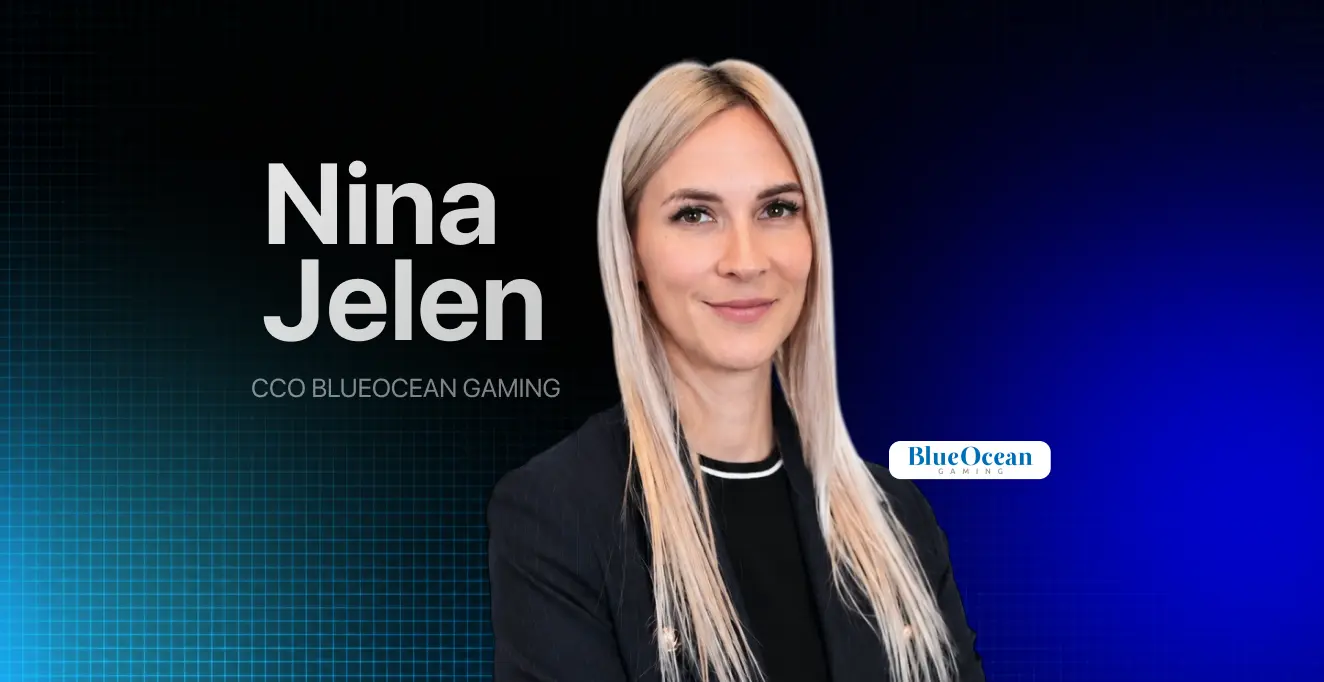
What turns a side product into the engine of a business? For BlueOcean Gaming, it was GameHub, now 14,000 games deep. CCO Nina Jelen explains why aggregation became the company’s core, why signing a contract is only the start, and how an independent B2B provider keeps its edge with White Label.
Clast: BlueOcean Gaming has grown from a land-based casino solutions developer to an aggregator offering over 150 providers and 14,000 games. At what point did you personally recognize that aggregation would become the company’s defining strength rather than simply one of several offerings?
Nina: When we first started developing GameHub, we already recognized that aggregation was becoming an increasingly important part of the industry. That was exactly why we decided to invest significant resources into building and developing the product.
Over the years, the market only confirmed that we were moving in the right direction. Demand for aggregation continued to grow, and we could see that operators were increasingly looking for more efficient ways to access content without having to manage dozens of separate integrations.
But what I find particularly interesting is how our understanding of aggregation has evolved. Initially, the focus was naturally on connecting providers and delivering content. Today, we see aggregation as something much bigger.
It is no longer just about how many games you can offer, but what you can actually do with that content. This is why we have continuously invested in expanding GameHub with promotional tools, AI-powered recommendations, real-time data, and social gaming features.
Looking back, I wouldn’t say there was one particular moment when we realized aggregation would become our strongest product. It was more of a direction we believed in from the beginning, and one that the market kept validating.
Clast: What commercial infrastructure and relationship management philosophy have made your company expansion sustainable rather than merely rapid?
Nina: I believe sustainable growth comes from having the right balance between strong relationships, reliable technology, and well-established internal processes.
Our industry has become increasingly competitive, so attracting new clients is only part of the equation. Just as much effort needs to go into supporting existing partners, understanding their changing needs, and helping their businesses grow over time.
For us, signing a contract is never the finish line. It is the beginning of a partnership.
We have invested a lot into building dedicated account management, technical support, and commercial teams that work closely together. We also focus on having clear internal responsibilities, measurable objectives, and regular performance reviews, because as a company grows, you cannot rely on informal communication and individual efforts alone.
At the same time, I strongly believe that relationships should never become just another number in a CRM. We want to understand our partners’ businesses, their challenges, and their ambitions.
Ultimately, sustainable growth is not just about how many new clients you bring in, but how many of those clients continue to grow with you.
Clast: As CCO, you’re simultaneously managing operator relationships, provider partnerships, and internal commercial strategy. How do you personally prioritize when these three constituencies have competing demands?
Nina: I would be lying if I said it was always easy!
It is a constant balancing act, or perhaps juggling is a better word.
We work with a large number of operators and game providers, and there are always new requests, opportunities, challenges, and developments happening simultaneously. Naturally, everyone would like their request to be the highest priority, and realistically, we cannot accommodate everything at once.
For me, the most important thing is maintaining open and transparent communication. Even when we cannot deliver something immediately, our partners should understand where things stand, what the next steps are, and when they can expect progress.
When it comes to prioritization, I always try to look at the bigger picture. Which initiatives will bring the most value to our clients? Which developments will benefit multiple partners rather than just one? And which decisions support our long-term strategy?
Our commercial strategy has always been centered around delivering better technology and more value to our clients. That helps us make decisions even when priorities compete.
Of course, there are days when everything feels urgent, but I think that’s also part of what makes this industry exciting.
Clast: From a commercial standpoint, how do you balance making White Label attractive enough to win clients while ensuring it doesn’t cannibalize your core aggregation business?
Nina: Our approach has been to develop features and technologies that can bring value to both solutions whenever possible. For example, many of the promotional and gamification tools we develop can benefit operators using our platform as well as those connected through GameHub.
This allows us to invest in innovation that strengthens our overall product ecosystem rather than creating completely separate development directions.
Commercially, I believe the most important thing is understanding what the client actually needs instead of trying to sell them the product we would prefer them to buy.
If an operator already has a strong platform, there is no reason to convince them to replace it. We would rather become their aggregation partner and help them grow through the technology they already have.
Clast: How does an independent B2B provider like BlueOcean Gaming maintain negotiating leverage when your operator clients are increasingly part of larger groups? Does that affect you in general?
Nina: Of course, we see this happening. Larger operator groups have greater purchasing power, and naturally, that comes with stronger expectations regarding commercial terms, service levels, and flexibility.
But I believe negotiating leverage should not come only from the size of your company. It should come from the value you bring to the table.
If you are offering exactly the same thing as everyone else, then the conversation will inevitably become about price. That is why differentiation is so important.
For us, this means investing in technology, promotional tools, operational efficiency, and flexibility. We want operators to see us not simply as another content supplier, but as a partner who can help them improve performance and develop their business.
We are open to adapting commercial structures for larger partners, particularly when there is a clear commitment to volume or long-term cooperation. However, there has to be a sustainable business case for both sides.
And I believe that flexibility becomes increasingly valuable as the industry consolidates.
Clast: Once you’ve mentioned following trends to find undiscovered markets. Can you walk us through a specific example where BlueOcean Gaming identified an emerging jurisdiction early and what the commercial execution looked like from your desk?
Nina: Following trends is important, but unfortunately there is no recipe that tells you exactly which market will be the right next move. I believe you need to combine the signals you see with conversations, experience, and a willingness to test your assumptions.
Looking back at our expansion, I wouldn’t single out one market. What has mattered more is recognising a combination of signals: growing enquiries from a region, partners exploring opportunities, or increased demand for particular types of content. These give us a reason to investigate further, but they do not guarantee success.
For us, the commercial work starts with understanding what operators actually need and whether we can support them effectively. That means reviewing market requirements, checking provider availability, and bringing our commercial and technical teams together to shape a relevant offering.
Our approach is to start with focused opportunities, learn from the response, and build from there. Following trends helps us recognise potential, but it is through listening to partners and adapting our approach that we turn that potential into sustainable business.
Clast: The pandemic accelerated online gaming adoption, but it also changed how B2B relationships are built. What sales and partnership practices have you permanently adopted from that period, and which have you deliberately abandoned?
Nina: Even before the pandemic, a lot of business in our industry happened remotely, but we still relied heavily on conferences and exhibitions to build relationships and move discussions forward.
The pandemic pushed us to become more proactive between those events. Online demos and regular remote check-ins became a more natural part of maintaining partnerships across different markets. That is something we have kept: you shouldn’t need to wait for the next exhibition to make progress.
What we have moved away from is the idea that every conversation needs a scheduled video call, or that more meetings automatically mean a stronger relationship. Sometimes a quick message is enough. Other times, meeting in person opens up a conversation about a challenge or opportunity that might never surface on a formal call. It is about choosing the right approach for the situation.
I like to draw a parallel with hospitality: technology can make the booking seamless, but it is the personal attention that makes you want to return. In our business, digital tools help us work efficiently, while understanding the people behind the business is what builds a lasting partnership.
Clast: As someone who’s watched operators succeed and fail, what’s the most common commercial mistake you see new operators/providers make in their first year?
Nina: I think one of the biggest mistakes is underestimating how complex and competitive this industry really is.
From the outside, launching an online casino might look relatively straightforward. You choose a platform, integrate some games, invest in marketing, and players start coming. But the reality is very different.
I sometimes compare it to becoming an influencer. From the outside, it might look like an easy way to make money, but behind every successful example there is usually an enormous amount of work, planning, consistency, and investment.
The same applies to running an online casino. Today, players have an incredible number of options, so simply launching another casino with the same games and similar bonuses is not enough. You need a clear vision, a strong business plan, sufficient resources, and most importantly, a reason why players should choose your brand over hundreds of others.
I believe new operators sometimes try to do too many things at once instead of identifying one area where they can genuinely stand out.
You don’t necessarily need to be the best at everything, but you should aim to be exceptional at something that matters to your players.
Clast: What’s your philosophy on hiring commercial talent in iGaming, do you prioritize industry veterans or bring in people from adjacent sectors and teach them the vertical?
Nina: Personally, I believe you need both.
Having experienced professionals who understand the industry, know the market, and have established relationships is extremely valuable. They bring knowledge that often takes years to develop, and they can help younger team members grow much faster.
But I think bringing in people from outside the industry is equally important.
Sometimes, when you have been working in the same industry for many years, you start accepting certain ways of doing things simply because that’s how they have always been done. Someone coming from a different sector might question those processes, introduce a completely different approach, or bring ideas that we would not necessarily have considered.
For me, the most important qualities are curiosity, initiative, adaptability, and the willingness to take ownership.
Industry knowledge can be learned, but the right mindset is much harder to teach.
I think the strongest teams are those where experience and fresh perspectives complement each other.
Clast: If you were advising a competitor entering the aggregation space today, what’s the one commercial truth about this business that took you years to fully appreciate?
Nina: That having more games doesn’t automatically mean having a good product.
When you first enter aggregation, it is natural to focus on expanding your portfolio. Every new provider and every additional game feels like progress, and of course, having a strong content offering is essential.
But over time, you realize that content alone is not enough to build a sustainable competitive advantage.
Operators need reliability, flexibility, fast integrations, efficient support, competitive commercial conditions, and increasingly, tools that help them get more value out of the content they already have.
I would also say that the complexity of aggregation is often underestimated. Every additional provider brings new technical requirements, commercial arrangements, reporting structures, and operational responsibilities.
So my advice would be to focus just as much on building the infrastructure and processes behind the product as on expanding the catalogue itself.
Because ultimately, the real value of an aggregator is not measured by how many games it can connect, but by how efficiently it can deliver, manage, and help operators monetize them.
Clast: Beyond revenue growth and provider count, what personal marker of success would tell you that BlueOcean Gaming has truly arrived as an industry leader?
Nina: For me, one of the most rewarding moments is seeing an idea turn into a real product.
Sometimes we start working on something that initially seems incredibly complicated. There are technical challenges, countless discussions, changes along the way, and moments when you wonder whether everything will come together.
But then you finally see that feature go live, clients start using it, and you realize that something which existed only as an idea a few months earlier is now creating real value.
Those moments give me an enormous sense of satisfaction, because they demonstrate what our team is capable of achieving.
I also think there is something to be said about longevity. BlueOcean Gaming has been part of this industry for more than 16 years, and in an environment that changes as quickly as iGaming, that is already a significant achievement.
We have experienced technological transformations, regulatory changes, new business models, and constantly evolving player expectations. Yet we have continued to adapt, develop, and find new opportunities.
For me, being an industry leader is not necessarily about being the biggest company in the room. It is about remaining relevant, continuing to innovate, and having partners who genuinely trust your technology and your people.
And perhaps the biggest achievement would be reaching a point where operators don’t just come to us because they need games, but because they want to know what we are developing next.