Salvatore Catalano: “Premium Slots Aren’t Defined by Budget or Graphics”
Spin2Win CEO Salvatore Catalano on slots, product identity, differentiation, distribution, operator expectations, AI and the future of premium iGaming content in a crowded B2B market.
Interview with Salvatore Catalano, CEO of Spin2Win
 Irina P
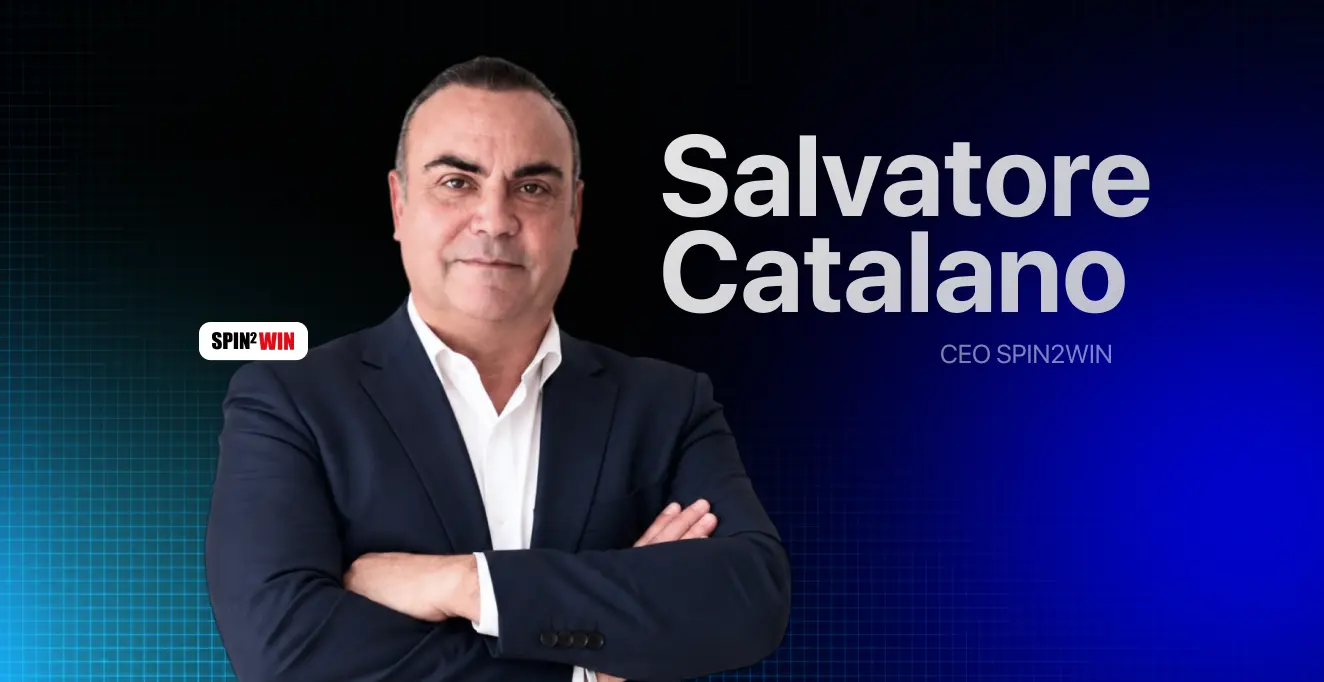
In Clast’s new interview, we invited Salvatore Catalano, CEO of Spin2Win, to talk about slots and the changing B2B iGaming niche: product identity, differentiation, distribution, operator expectations, AI, the trends shaping premium content and what it takes to stand out in a crowded market.
Clast: How do you define Spin2Win Studio’s role in today’s iGaming market?
Salvatore: Spin2Win is a specialist B2B game provider with a clear product identity and a very specific role within the wider iGaming ecosystem.
We are not trying to be everything to everyone. Our job is to create games that have a reason to exist — whether that comes from the mechanic, the format or the overall concept — and then build the right distribution around them through operators, aggregators, platforms and strategic partners.
A strong product creates the opportunity, but iGaming is an interconnected business. Distribution, commercial execution and relationships are what allow that product to reach the right markets and generate value over time.
For me, our role is therefore very clear: build products we believe in, understand where they belong and work with the right partners to take them there.
Clast: Which decisions have shaped Spin2Win the most?
Salvatore: One of the most important decisions was not to define Spin2Win around a single game format. Slots remain fundamental to our catalogue, but video poker, crash, Mines and other formats have allowed us to develop different kinds of expertise and address different types of casino content.
Another important decision was recognising early that developing a good game is only part of the job. Distribution, integrations and commercial relationships have to be treated with the same strategic attention as the product itself.
And, as the company has grown, we have become increasingly selective about growth. Not every new product, market or partnership is automatically the right one. Knowing where to concentrate resources — and sometimes where not to — has shaped Spin2Win just as much as the opportunities we have pursued.
Those choices have given us a broader catalogue, stronger distribution and a much clearer understanding of the company we want to build.
Clast: What do operators expect from a B2B casino game provider today? Have the requirements changed in any way over the years?
Salvatore: The expectations have definitely increased. Good games are still the starting point, but operators now evaluate the complete relationship. They expect technical reliability, efficient integration, responsive support, a consistent product pipeline and a provider that understands how its content will actually fit into their casino offering.
Flexibility has also become much more important. Different operators have different audiences, commercial priorities and promotional strategies. A provider cannot assume that exactly the same approach will work for every partner.
So I think the relationship has evolved from simply supplying content towards becoming a genuine B2B partnership. Product quality gets you into the conversation, but reliability and the ability to work well together determine how far that relationship can develop.
Clast: How do you choose which markets and partners are right for Spin2Win?
Salvatore: We start with fit rather than size. A large market is not automatically the right market for us, just as a large company is not automatically the right partner. We look at whether our catalogue makes sense for that audience, whether there is demand for the formats we produce and whether we have a credible distribution and commercial route into that market.
With partners, reach is important, but execution matters just as much. We want to understand the network they can give us access to, how they work with providers after integration and whether there is a genuine opportunity for both sides to develop the relationship.
An integration is a starting point, not the objective. What matters is what happens afterwards: whether the games actually reach the right operators and audiences, and whether both companies continue creating value together.
I would always prefer productive partnerships with real activity behind them to a longer list of integrations that exist mainly on paper.
Clast: What is your approach to building long-term trust with B2B clients, operators, and other partners?
Salvatore: Trust develops when both sides understand that the relationship extends beyond the immediate transaction.
You need to understand what the other company is trying to achieve, be transparent about your own objectives and remain engaged after the agreement has been signed or the integration has gone live. That is when a commercial relationship either begins to develop into a partnership or remains simply a transaction.
Personal relationships matter enormously in this industry. B2B business is still ultimately conducted between people, and trust between those people can create a level of openness that makes the relationship stronger.
But personal chemistry cannot replace business value. The strongest partnerships, in my experience, are the ones where the personal relationship creates openness and the companies behind it consistently give that trust a reason to continue.
Clast: What is the biggest challenge facing premium slot providers right now?
Salvatore: The volume of content entering the market is enormous. Operators have increasingly broad catalogues and every new title is competing for visibility. In that environment, simply producing more games is not a differentiation strategy.
The challenge is to create something that deserves its place in the catalogue and gives the operator a credible reason to support it. The concept, mathematics, mechanics, visual identity and overall experience have to reinforce one another.
At the same time, the market expects providers to move quickly. The difficult balance is maintaining speed without allowing production volume to lower the standard of what you release.
For me, “premium” is not defined by the size of the production budget or by graphics alone. It is the quality and coherence of the entire process — from the original idea and mathematics through to execution, delivery and how the product performs as a complete experience.
Clast: How do you differentiate Spin2Win in a crowded iGaming landscape?
Salvatore: I do not think differentiation comes from declaring that you are different. The product has to demonstrate it.
One characteristic of Spin2Win is the breadth of the way we approach casino content. Our catalogue ranges from slots and video poker to crash and Mines, so we can work with very different forms of interaction rather than forcing every idea into the same structure.
There is also an interesting balance between experience and experimentation in the company. We understand traditional casino formats, including categories such as video poker, but we are equally interested in newer interaction models and in how those formats can evolve.
Ultimately, however, differentiation comes from discipline. There is always a mechanic, theme or format attracting attention in the market. Market intelligence matters, but following a trend is not the same as understanding it.
Our objective is to identify where there is genuine demand and then find a Spin2Win way of addressing it.
Clast: What does effective leadership look like in a fast-moving B2B gaming company?
Salvatore:
For me, leadership is a combination of clarity, prioritisation and accountability.
People need to understand where the company is going, what matters now and what does not. In a fast-moving business, one of the biggest risks is confusing activity with progress. There will always be another market, another integration, another product idea or another opportunity competing for attention.
A CEO has to decide where the organisation should concentrate its resources and also have the discipline to say no when something takes the company away from those priorities.
I stay close to product and commercial decisions, but being involved does not mean making every decision myself. If you have specialists with deeper expertise in mathematics, engineering, product, art or commercial development, good leadership means making use of that expertise rather than overriding it.
A CEO should set direction, make difficult choices and take responsibility for the outcome. He should not become the bottleneck.
Clast: What role does AI play in your current work? What is your take on AI-personalization, has it already become a necessity for providers?
Salvatore: AI already has a practical role in the way we work. We use it selectively where it can improve efficiency — for research, analysis and repetitive processes — but I see it as a tool that supports professional expertise rather than replacing it.
That distinction matters particularly in creative work. AI can accelerate parts of the process and open up new possibilities, but somebody still has to understand the product, make the decisions and take responsibility for the final result. Human judgement remains essential.
On personalisation, I would distinguish between the operator or platform level and the game provider level. For operators, AI can already play an important role in recommendations, CRM and content discovery — essentially helping the right content reach the right audience.
For a game provider, I would not say that AI-personalisation inside every individual game has become a necessity. What is becoming increasingly important is creating content that can work effectively within personalised environments: content that can be understood, categorised, promoted and presented to the audiences most likely to value it.
In many ways, I think AI will transform how games are discovered and distributed before it fundamentally transforms the games themselves.
Clast: What trends will shape premium iGaming slots over the next three to five years?
Salvatore: I think stronger product identity will become increasingly important.
There is already an enormous volume of content in the market, and individual mechanics or attractive graphics are relatively easy to reproduce. The more difficult challenge is creating a game that people can recognise and remember. That identity can come from a mechanic, a character, a visual world or a broader product concept that is strong enough to develop over time.
I also expect much more cross-pollination between slots and other forms of digital entertainment. Progression, clearer visual feedback, more active decision points and interactive bonus structures will continue to influence slot design. The challenge will be to introduce those elements without making the game unnecessarily complicated.
A third major factor will be greater attention to individual markets. International distribution will continue to be important, but the idea that exactly the same content strategy should work equally well everywhere is becoming less convincing. Understanding local preferences, familiar formats and the way operators build their catalogues will matter more.
So I think premium slots will become more recognisable, more interactive and more market-aware. But the principle underneath all three trends is the same: sophistication only adds value when the player can still understand the experience.
Clast: If you could set one clear goal for Spin2Win’s next chapter, what would it be?
Salvatore: To scale internationally without diluting what made the company worth scaling in the first place.
For Spin2Win, that means broader and more effective distribution, deeper relationships with operators and strategic partners, and a catalogue capable of performing across different game categories while maintaining a clear standard of quality.
I do not want growth to become an exercise in counting releases, integrations or countries. Those numbers only matter when there is real activity and commercial value behind them.
The next step is therefore not simply to produce more; it is to make what we produce travel further. That means reaching the right markets, strengthening distribution and building partnerships that become more valuable after launch rather than ending with the integration.
If I had to reduce our next chapter to one goal, it would be this: turn the strength of our products into international scale without losing our identity.